THE GOOD OLD AND THE BLAME DAYS
As much as it grieves me to say it, while “the good old days” and “blame it on the media” are simplistic cliches, in the space of two weeks, they have combined as a succinct summation of the state of the news business.
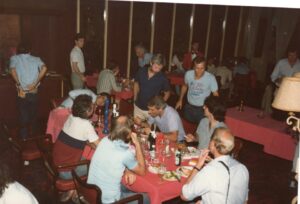
The legendary journalist hotel, the Commodore in Beirut, which just closed forever, was “the good old days” writ large.
Courtesy of the Byzantine connections of its owner Yussef Nazzal, the Commodore was a safe haven from the armed idiots who ruled the streets of Beirut in the 1970s and ‘80s. In the days before cell phones and portable satellite equipment, it also had what journalists in war zones valued most: a reliable telex line. (That the bar was always open and whatever you spent in it appeared on your bill as telex and laundry services was an added bonus.)
TV stories had to be in a taxi on the way to a satellite link in Amman by nightfall, which meant the bosses in New York had to trust your news judgement.
None ever demanded, as the new CBS editor Bari Weiss did in a recent memo to staff, that “… every single night has something with viral potential.” The memo also exhorted staff to “drive” the news.
Ms Weiss could do with the lesson taught to me by the editor who sent me to the first war I ever covered, Angola 1975.
His “herogramme” to myself and two colleagues for a front page story on a firefight in which we became targets, ended with the line: “Kindly remember uncan (telexese for ‘you cannot’) file if dead.”
A succinct reminder that the job is to tell, not be the story.
The power of TV news is to take people places they’ve never been, show them things they’ve never seen and tell them what they need to know.
You can’t do that with a “star” waving hands and arms about and yammering to the camera.
It requires pictures, sound and a well-crafted narration, written by the reporter who was on the scene.
According to one report, one night Ms. Weiss and her aides were rewriting an Evening News script until just before airtime.
Here’s some TV 101 for them: TV and print writing differ in sentence structure, and narration has to work with pictures.
Average narration speed is 2.5 words per second, about 250 words in a one minute 45 second piece (a luxury these days). A sound bite or two and some natural sound to add texture, and you’re down to about 200 words.
It took a hell of a lot of patience on the part of talented producers and editors to help me make the transition from print to TV.
I seriously doubt Ms Weiss or any of her acolytes with no TV experience can write that concisely and coherently from the get-go.
A LITTLE MORE CLARITY
CBS now wants its on-air people to inject more personality and informality into the newscast.
“Informality” seems to me to be the polar opposite of serious, believable or gravitas, crucial elements that add up to credibility.
When I joined CBS (in, yes, “the good old days”), I was told that CBS style is “the unique abilities of our correspondents”.
Correspondents and producers were also free to fight their corner when it came to script alterations, story angle, content and — believe it or not –executive decisions.
Ms Weiss has blamed some subordinates for not staunching the criticism being heaped upon her and CBS.
Madam, criticism is what you learn from. Staunching it is perpetrating ignorance.
Speaking of which: the lede under the New York Times headline “Trump Says Iran Is Stopping Its Killings of Protesters …” read: “President Trump said on Wednesday that the Iranian government appeared to have stopped killing protesters…”
The headline was definitive, while the lede carried a caveat, which would make it a prima facie case for “blame it on the media”.
The backup quote from Trump added confusion: “We’ve been told that the killing in Iran is stopping — it’s stopped — it’s stopping.”
Given that Trump’s meandering syntax could mean either, both at the same time or nothing, surely the statement demanded a follow-up for clarification, instead of leaving it up to the reader to decide whether the killing was slowing down, or had actually stopped.
The story went on to note that Trump said he had received the information from “very important sources on the other side” and would “find out” later if it was accurate.
What sources? Iranian officials? An actual intelligence source? Or his own head?
In the days of presidents who for the most part spoke coherently, the issue of clarity rarely cropped up, and if it did, would have been addressed.
What constitutes “the good old days” may for the most part, be a product of fond if fading memories.
But “blame it on the media” was more often than not a minority position.
Comments are welcomed. Click CONTACT on the site header.
To receive e‑mail alerts to new posts, Click SIGN-UP on the header.
5 thoughts on “THE GOOD OLD AND THE BLAME DAYS”
This may be apocryphal, but do you remember the Newsweek correspondent in Johannesburg — I won’t mention his name but, as I recall, he was about your vintage — who submitted expenses for dozens of bottles of Perrier water at the Commodore in Beirut because he said there was no tap water for washing or flushing?
I think I know who you mean.He was an expense account master
Yay .. I’ve made into Pizzeysperch! .. if only the back of my head in a photo in Beirut .. the good old days indeed!
Your observations are spot on, particularly in light of Dukopil’s nightly injection of him into the EveNews and his end-of-show celebrations about how wonderful his broadcast has been.
I wonder if it’s him doing what he thinks is a winner, or doing what he’s told by people who are one their way to being certified wreckers. Not much of a legacy either way.