TO FRIENDS ABSENT BUT NOT FORGOTTEN
In his memoir “Night”, the author Elie Weisel wrote: “To forget the dead would be akin to killing them a second time.” As you read this, glasses have been, or are being raised to ensure that does not happen to Paul Douglas and James Brolan.
Paul and James were killed, and correspondent Kimberly Dozier was horrifically wounded, by a car bomb on a Baghdad street corner on May 29, 2006. They were, ironically, doing a story about American troops spending Memorial Day on patrol.
U.S. Army Capt. James Funkhouser and an Iraqi translator we still only know as ‘”Sam” were killed in the same explosion.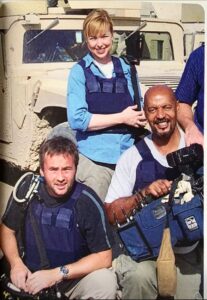
Reporters, producers and camera crews who place themselves in harm’s way do it out of choice, and while that may seem irrational, Paul, James and Kimberly would have assessed the story as worth the risk.
None of us who cover wars are so vain as to think we can change the world. But we believe we can make a difference. If we do our jobs well, the excuse “we didn’t know” cannot be used to justify inaction or indifference in the face of evil or suffering or injustice. You did know, because we who survived and those like Paul and James and Kimberly and too many others who have died and been injured went there, and told you.
So what was special about Paul and James, you might ask?
Well…
To call Paul Douglas “larger than life” isn’t a cliché, it’s a gross understatement,
He was physically huge, black, shaven-headed, with a booming voice that could silence a room with a syllable, and had a smile and a heart as big as his courage, which is another way of saying enormous.
Good cameramen must put emotion aside to do their job, but if they lack empathy, their pictures will fail to capture the essence of raw human emotion.
In the madness of 1990s Sarajevo, you couldn’t go anywhere with a TV camera without kids asking if “chelo bonbon” was with you. “Chelo” is the phonetic spelling of the Serbo-Croat word for bald. “Bonbon” was what the kids called candy, They would lay siege to get one.
But when the huge bald black man showed up, they dutifully stood in line for a bonbon from the bulging pockets of his trademark fisherman’s vest, and that smile.
But woe betide anyone who tried to stop Paul getting a picture he wanted.
When the Serbs were expelling ethnic Albanians from Kosovo into Macedonia, we followed a train full of refugees to a siding. The scene could have been from the movie “Schindler’s List”, pleading hands sticking out of carriage windows, people wailing inside, doors wired shut.
Several armed Macedonian police blocked us from approaching it. We argued fruitlessly for a few minutes, then Paul said, in a calm and measured tone, “Sorry mate, but I have to take pictures.”
By the time the police recovered from being unceremoniously shouldered aside, he had the shots we needed.
In his history of war reporting, “Dying for the Truth”, author and former war correspondent Paul Moorcroft wrote: “War correspondents are crucial to democracy and the public’s discovery of the truth. Without the media, the temptation to manipulate events with propaganda could be irresistible to politicians of all hues.”
Nobody manipulated James Brolan. In one legendary incident, a newbie-to-a-war-zone producer ordered him to take a higher than acceptable risk because, “I’m in charge.”
James replied: “Apparently not.”
A laconic nature and laid back image belied James’ technical competence and dedication. Soundmen provide the essential, subtle underpinning that make the difference between an average and a great TV news story.
Watch a good soundman work and often his microphone is not pointing where the camera is aimed, because the ambience, the deeper meaning of the image, is sound coming from another direction.
James Brolan knew where to listen. And man, he was fun to work with.
WHAT THEY DID
Variations of the quote “The first casualty when war comes, is truth,” have been attributed to pundits and thinkers ranging from the ancient Greek writer Aesculus, to American Senator Hiram Johnson in 1917.
The degree of truth is arguable according to point of view and agendas, but not because journalists are trying to hide the truth.
In too many cases, like Gaza, journalists die because someone else is trying to do so.
“Fake news” is a charge spewed by those who fear truth, who don’t want light shone into their dark corners.
If you want or are willing to deal in and purvey it, the only thing you put in jeopardy is any pretence of honesty, objectivity and principles.
It’s what you get when people who purport to be journalists base their reporting on an ideological bent, as opposed to those willing to assess a risk and accept the odds on how much of their luck fund they’ve already spent.
Remember that, and as we who knew James and Paul 20 years ago will continue to do, hoist a glass in a homage and a toast, so they do not suffer the fate Weisel warned against.
Comments are welcomed. Click CONTACT on the site header.
To receive e‑mail alerts to new posts, Click SIGN-UP on the header.
To SHARE, click the appropriate icon below.
6 thoughts on “TO FRIENDS ABSENT BUT NOT FORGOTTEN”
James was a mensa member. If memory serves me well. Tks for that piece. It makes them shimmer into view if ever so briefly.
Love the tribute.
Beautiful words and even better that they are remembered not only by loved ones but also by their colleagues—also family .
A lovely and fitting tribute, Pizz.
Cheers to Paul and James.
Great tribute, Pizz.
A wonderful .. and timely .. tribute Pizz. I never worked with James, but laughed out loud at “Apparently not.” He was obviously a man worth knowing. Paul was indeed larger than life and I loved working with him. Hell, I loved just being around him.
I sincerely hope your tribute does NOT turn out to be an elegy for our business.